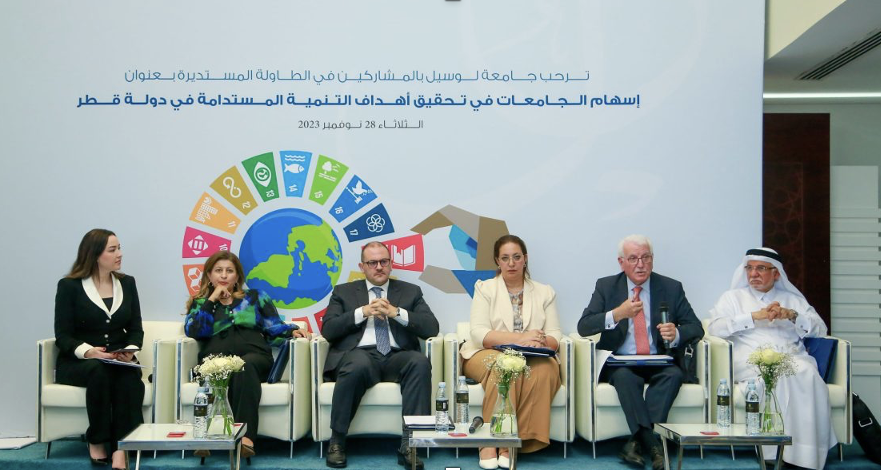
Qatar – 28 November 2023:
The Center for Training and Continuing Education at Lusail University organized a roundtable on “Universities’ Contribution to Achieving the Sustainable Development Goals (SDGs) in Qatar.” This event marked the beginning of collaboration with CIFAL, a network of training centers under the United Nations Institute for Training and Research (UNITAR). The roundtable featured distinguished participants from the fields of education and sustainable development. Discussions focused on the crucial role of universities and the challenges students face in pursuing the SDGs in today’s world.
H.E. Mr. Ali Zeinel, Advisor for International Cooperation at the Ministry of Culture and former Permanent Delegate of Qatar to UNESCO, highlighted the role of education in understanding the SDGs and emphasized the importance of building leadership and innovation skills. He stressed that achieving these goals requires activating partnerships and promoting inclusive education, while providing comprehensive opportunities for learning and personal development that contribute to building a sustainable future.
Prof. Dr. Mohieddin Shaaban Touq, Member of the Board of Trustees of Lusail University and former Minister of Higher Education in Jordan, highlighted the impact of universities on achieving the SDGs through research, education, and industry collaboration. He noted that universities contribute not only to SDG 4 (Quality Education) but to most, if not all, of the SDGs through their curricula, research programs, and engagement with industry and business. He also provided initial insights on how Qatari universities can strengthen their capacity to contribute to the SDGs and participate in international assessments.
Dr. Sawsan Al-Banzarti, Assistant Professor and Sustainable Development Course Coordinator at Lusail University, emphasized the university’s role in raising students’ awareness of the importance of sustainable development and its central role in achieving it. Since its establishment in 2020, Lusail University has integrated SDG-focused policies, infrastructure, partnerships, and academic programs into its operations. The university continues to establish its position in the educational landscape while reinforcing its economic and social relevance through local and international partnerships and agreements, advancing the SDG agenda.
Eng. Samer Franjieh, Deputy Director General of Risk and Compliance at Qatar Development Fund, stressed the importance of intensifying efforts to achieve the 2030 SDG agenda, noting that only six years remain until its target date. He highlighted the need for coordination among all stakeholders in Qatar, including government bodies, universities, schools, the private sector, civil society organizations, and funding institutions. Universities play a particularly important role by focusing research and developing students’ scientific and practical skills, especially in addressing social, economic, and environmental issues linked to the SDGs.
The roundtable concluded with Dr. Esmat Zaidan, Associate Professor at the College of Public Policy at Hamad Bin Khalifa University, who discussed the transformative role of higher education in sustainable development. She outlined how higher education institutions have evolved to adopt the SDGs within academic, research, and community settings. Higher education institutions play a vital role in fostering innovation, educating individuals as global citizens, and disseminating knowledge to advance communities, where universities act as catalysts for social transformation and progress toward achieving the SDGs.
This event is part of ongoing efforts to highlight the role of universities and educational institutions in Qatar in achieving the SDGs and emphasizes the urgent need to strengthen cooperation and partnerships to build a sustainable future for coming generations. Key outcomes from the roundtable included:
• Raising public awareness about the importance of sustainable development and supporting campaigns aimed at educating students on this issue.
• Developing joint strategies and intensifying collaboration among local universities and relevant stakeholders to advance sustainable development, particularly at the local level.
• Highlighting challenges hindering the achievement of the SDGs and emphasizing the need to strengthen partnerships between schools, universities, and the local community.